
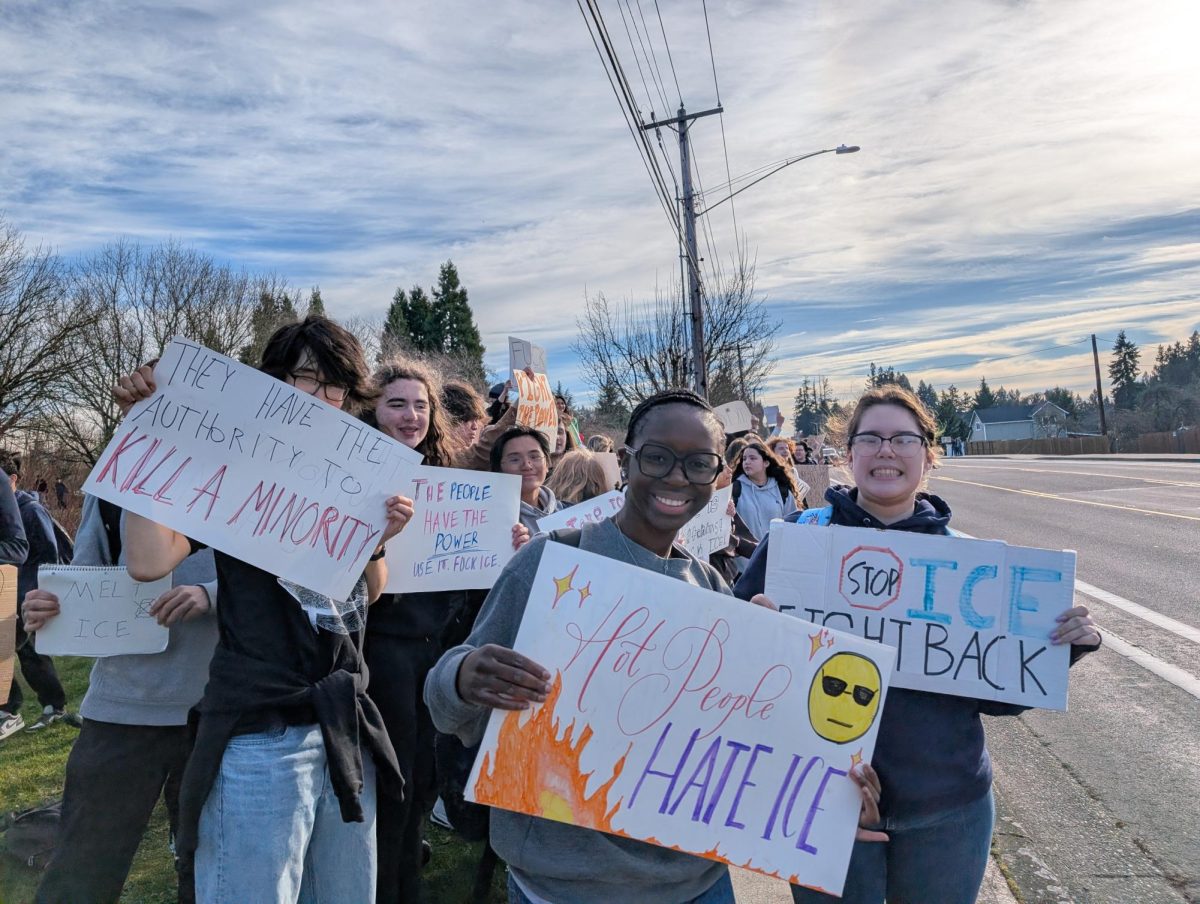
Students walked out of their classrooms at Tualatin High School (TuHS) on Jan. 20, signs in hand, to protest ICE activity under the Trump Administration in the wake of Minneapolis violence. The large, participating crowd lined up along Boones Ferry Road, where they held up their signs for the community to see and called out chants. The walkout began during the third period at 2 p.m., dissipating at around 3:45, when school normally gets out.
An anonymous student at the walkout commented on why they wanted to participate.
“I just wanted to say I grew up with, surprisingly–this is becoming a rare thing nowadays–but it’s called empathy, and everyone is a human being in my eyes. No matter where you come from, you have every right to be in the place that you choose,” they said.
Another commented, “I’m here to really protest for my people, for all the Hispanic community. I’m here to also protest against ICE and to protest for our rights because as young students for the next generation, it’s important for us to speak up.”
The protest was part of a national movement known as the “Free America Walkout,” started by the Women’s March. Hundreds of students across schools in Portland, as well as students from Tigard High School participated. Juniors Madeline Rowe and Mahaela Horsford organized the walkout at TuHS.
“This is very needed. I think that the student body as a whole understands the necessity of this,” said Rowe. “We have had people from our school who have been deported in the past year, and that’s absolutely terrifying that that’s happening.”
Rowe saw the walkout as an opportunity for the community to make their voices heard. She expressed frustration with the lack of youth involvement in combating political issues and injustices.
“When I go to protests, I don’t see a lot of youth there because I think that there’s very much this idea of, ‘Oh, my voice doesn’t really matter. Me being there isn’t going to make a difference,’” she said.
The walkout gave students nearby a platform that allowed them to raise their voices together against the discrimination, oppression and violence perpetuated by ICE.
“When people are able to see the importance of their voice and see that they can actually make a difference, that’s how we get things to change in our world,” said Rowe. “Nothing has ever changed because people were mad about it and didn’t say anything. That’s not how change works. You have to be loud to get real change. You have to stand up and really use your voice and your presence and your privilege. I think it’s really important to see a lot of people who aren’t directly affected by this, protesting. Yes, maybe it doesn’t directly affect me, but it affects people that I know and people that I’m really close to, and more than that, it’s just affecting people in general, and that should be enough.”
Students’ feelings against ICE were partially inflamed by the Jan. 7 shooting of Renee Good by ICE agent Jonathon Ross in Minneapolis. Since then, Minneapolis has become the site of many protests and even more violence. Alex Pretti, a 37-year-old nurse at an ICU was also killed by federal immigration officers in Minneapolis on Jan. 24. ICE activity continues to cause fear and disruption in the city.
The Portland area has faced its own recent struggles against ICE. Prompted by tear gas thrown at a peaceful demonstration with children present, Mayor Keith Wilson demanded in a statement that ICE leave Portland. Additionally, a Gresham 7-year-old and her parents were recently arrested and detained by ICE at a Portland hospital while seeking medical treatment for their daughter.